球磨辅助DES预处理Simultaneous production of high-concentration sugar and purity lignin from wheat straw via ball-milling assisted DES pretreatment for high-loading enzymatic hydrolysis
星期一, 8 6 月, 2026Simultaneous production of high-concentration sugar and purity lignin from wheat straw via ball-milling assisted DES pretreatment for high-loading enzymatic hydrolysis
Recently, PhD student Miss Li Wang supervised by Prof. Zhen Fang, collaborated with Prof Roger Ruan (Minnesota Univ, USA), published a research paper in the international academic journal Biomass and Bioenergy (Q1; Impact factor: 5.8) on the simultaneous production of high-concentration sugar and purity lignin from wheat straw.
A green pretreatment strategy using ball-milling assisted deep eutectic solvent (composed of choline chloride, ethylene glycol, and oxalic acid) on wheat straw was developed. Under optimized pretreatment conditions (110 ◦C, 1:10 (m/v), 2.5 h), 82% lignin and 99% hemicellulose were removed. Glucose concentration reached 220 g/L after 120 h of enzymatic hydrolysis with 10 FPU/g cellulase and 2.5% PEG 6000, which was 7.3% higher than the result obtained without PEG 6000. This is one of the highest glucose concentrations reported for fed-batch enzymatic hydrolysis at such low enzyme loading (10 FPU/g). This high glucose concentration resulted from substrate modifications (reduced hydrophobicity, enhanced specific surface area, and exposure of more reducing ends) that created optimal attack sites for cellulase. The fed-batch strategy further improved hydrolysis efficiency by increasing free water and restricting cellulase adsorption by lignin. Meanwhile, lignin with high purity (97.6%) and uniform molecular weight was obtained. Unlike most existing pretreatment strategies that prioritize either sugar yield or lignin quality, this study achieved the co-production of high-concentration sugar and high-purity lignin, thereby advancing a sustainable biorefinery for lignocellulose valorization. Related results were published in Biomass and Bioenergy:
L Wang, J-Y Chen, Y Cao, Roger, Ruan, Zhen Fang*, Simultaneous production of high-concentration sugar and purity lignin from wheat straw via ball-milling assisted DES pretreatment for high-loading enzymatic hydrolysis. Biomass and Bioenergy 2026, 215, 109655. https://doi.org/10.1016/j.biombioe.2026.109655.
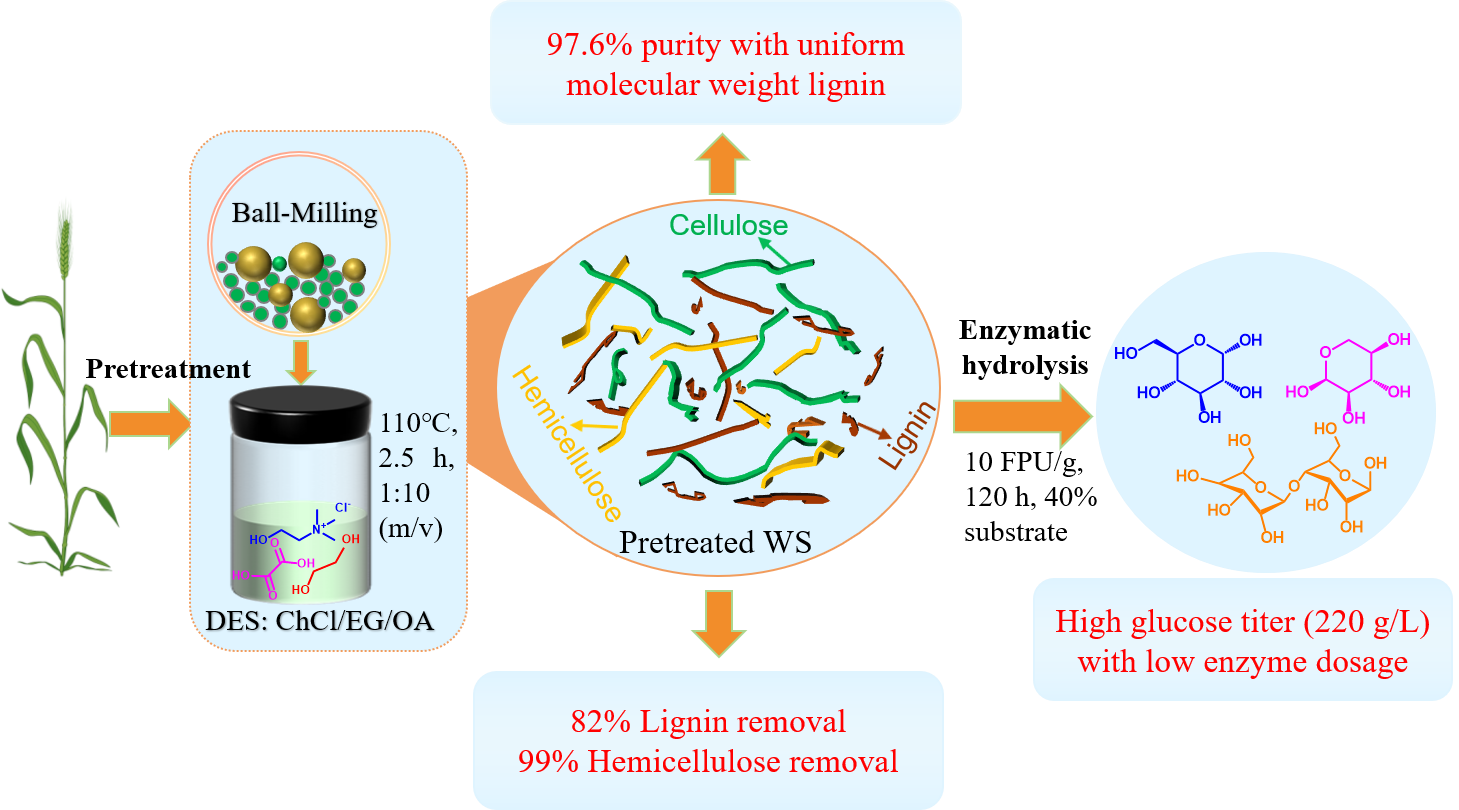
Ball-milling assisted deep eutectic solvent achieved high glucose titer with low enzyme dosage and high purity with uniform molecular weight lignin from wheat straw (球磨辅助DES预处理小麦秸秆联产高浓度糖与高纯度木质素)
球磨辅助DES预处理小麦秸秆联产高浓度糖与高纯度木质素
最近,博士生王莉(女)在方真教授的指导下,与美国明尼苏达大学阮榕生院士合作,在国际学术期刊Biomass and Bioenergy (Q1; Impact factor: 5.8)上发表了一篇关于利用机械化学预处理同时生产高纯度糖和高浓度木质素的研究性论文。
本研究提出了一种绿色预处理策略,即采用球磨辅助的低共熔溶剂(由氯化胆碱、乙二醇和草酸组成)处理小麦秸秆。在优化条件(110 °C、料液比1:10、处理2.5小时)下,木质素脱除率达82%,半纤维素脱除率达99%。随后采用10 FPU/g纤维素酶和2.5% PEG 6000进行酶水解,经120小时后,葡萄糖浓度达到220 g/L,比未添加PEG 6000时提高了7.3%。在如此低的酶加载量(10 FPU/g)下,这一葡萄糖浓度属于分批补料酶水解报道中的最高水平之一。该优异表现归因于底物性质的改变(疏水性降低、比表面积增大、还原端暴露增多),为纤维素酶创造了有利的攻击位点。同时,分批补料策略通过增加自由水含量并抑制木质素对纤维素酶的吸附,进一步提高了水解效率。此外,所获得的木质素纯度高(97.6%),分子量均一。与多数优先追求糖产率或木质素质量的现有预处理策略不同,本研究实现了高浓度糖与高纯度木质素的联产,为推动木质纤维素可持续生物炼制提供了新路径。
结果发表在Biomass and Bioenergy:
L Wang, J-Y Chen, Y Cao, Roger, Ruan, Zhen Fang*, Simultaneous production of high-concentration sugar and purity lignin from wheat straw via ball-milling assisted DES pretreatment for high-loading enzymatic hydrolysis. Biomass and Bioenergy 2026, 215, 109655. https://doi.org/10.1016/j.biombioe.2026.109655.